
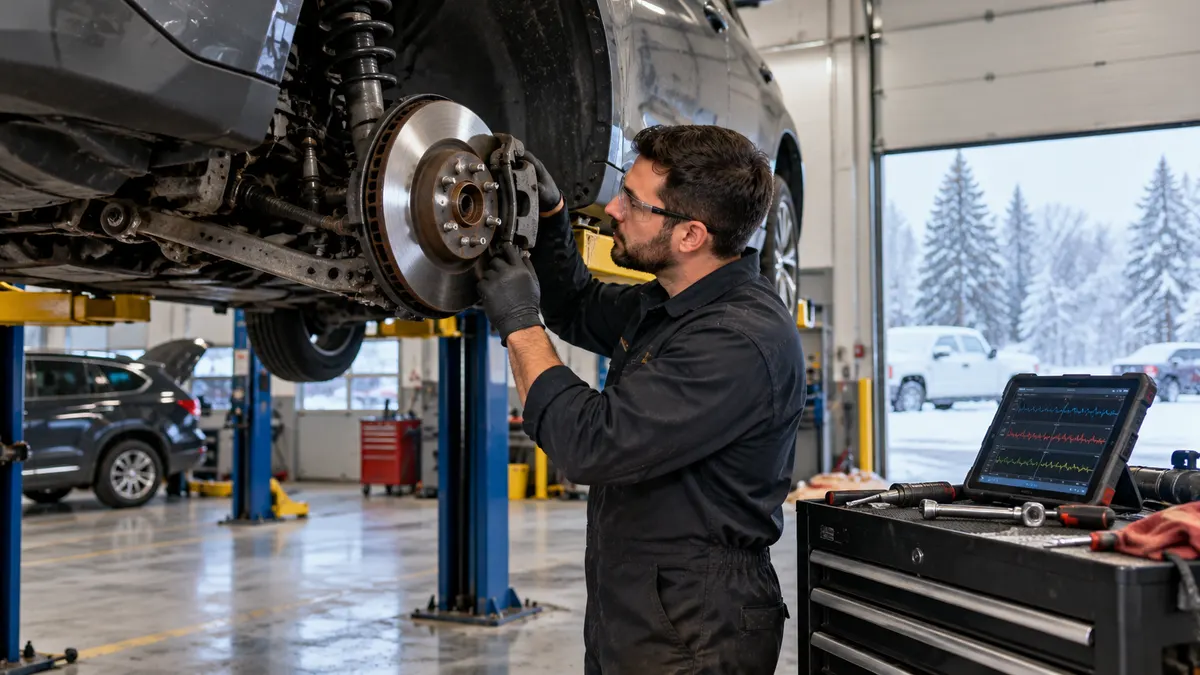
What the 310S exam is
The 310S exam is the certifying exam for Automotive Service Technician in Ontario. It is the Red Seal Automotive Service Technician exam: 125 multiple-choice questions in four hours, with a 70% pass mark. Passing it leads to your Certificate of Qualification (C of Q) from Skilled Trades Ontario and a Red Seal endorsement.
Automotive Service Technician is a compulsory trade in Ontario under the Building Opportunities in the Skilled Trades Act, 2021. To work in the trade you must hold a Registered Training Agreement, a Provisional Certificate of Qualification or a C of Q, and appear on the Skilled Trades Ontario Public Register. The apprenticeship is about 7,220 hours: 6,500 hours on the job and 720 hours of in-school training over three levels. Experienced workers without an Ontario apprenticeship can apply through a Trade Equivalency Assessment.
| Part of the exam | What to expect |
|---|---|
| Questions | 125 multiple-choice questions, each worth one mark |
| Options | Four choices, exactly one correct |
| Writing time | Four hours |
| Pass mark | 70% |
| Supplied at the exam | An acronym list, a calculator if needed, and other reference material if required |
| Exam fee in Ontario | $150 plus HST, paid through the Skilled Trades Ontario Portal |
| Language | English or French |
| If you do not pass | A mandatory 30-day wait before you can rewrite, and the exam fee is paid again |
This exam leans hard on diagnosis. The Red Seal program says that for this trade only 5 to 15% of questions test knowledge and recall, 40 to 50% test procedures and application, and 40 to 50% test critical thinking. Expect scenario questions: a symptom, some test readings, and a choice of causes or next steps. Four hours for 125 questions gives you just under two minutes a question.
How the exam is weighted
Red Seal exam questions come from the Red Seal Occupational Standard for the trade. The official exam breakdown gives each major work activity a set number of questions. Our eight sections follow the same activities, and our 125-question mock exams use the same weighting.
| Major work activity | Red Seal questions | What it covers |
|---|---|---|
| A. Common occupational skills | 9 | Safety, hoists and jack stands, tools, measuring, service information |
| B. Engine and engine support systems | 22 | Compression and leakage tests, fuel trims, cooling, gasoline and diesel fuel, emissions, turbochargers |
| C. Vehicle module communications | 12 | CAN and LIN networks, U codes, module programming, scan tool data |
| D. Driveline systems | 17 | Clutches, manual and automatic transmissions, planetary gears, differentials, CV joints, 4WD and AWD |
| E. Electrical and comfort control systems | 23 | Ohm's law, voltage drop, batteries, starting and charging, A/C and HVAC controls |
| F. Steering, suspension, brakes, tires and wheels | 23 | Alignment angles, hydraulic and ABS brakes, stability control, tires, TPMS, wheel bearings |
| G. Restraints, body components, accessories and trim | 10 | Airbags and pretensioners, occupant sensing, ADAS calibration, power accessories |
| H. Hybrid and electric vehicle systems | 9 | High-voltage safety, isolation, regenerative braking, inverters, DC-DC converters, charging |
Within activity A, the task on communication and mentoring techniques carries no exam questions, so we do not test it either.
Calculations you should be fast at
Most of the exam is diagnosis, but a few numbers come up again and again. Practise until these feel automatic:
- Ohm's law and power. Current = voltage / resistance, power = voltage x current, series and parallel resistance.
- Network resistance. Two 120 ohm terminating resistors in parallel read about 60 ohms across a CAN bus.
- Gear ratios. Driven over driving teeth, final drive, overall ratio, and simple planetary ratios.
- Engine figures. Displacement from bore and stroke, and compression ratio from swept and clearance volume.
- Brake hydraulics. Force = pressure x area at the master cylinder and the caliper piston.
- Tire size. Sidewall height and overall diameter from a size such as 225/60R17.
How to prepare
Start with the official Red Seal exam breakdown and self-assessment to find your weaker areas, and study from the Red Seal Occupational Standard, not only your college notes, because the exam covers the trade across Canada. Pay attention to the newer topics: vehicle networks, driver assistance calibration, and hybrid and electric vehicles are all on the exam. Then drill one section at a time here, read every explanation, and finish with full timed mocks of 125 questions in four hours. Aim to score well above 70% in practice so a few hard questions on the day do not sink you.
Checked against Red Seal Program and Skilled Trades Ontario information on October 12, 2026. Last reviewed: October 2026.
Aptitude Tests Canada is an independent practice platform. We are not affiliated with or endorsed by Skilled Trades Ontario, the Red Seal Program or the Government of Ontario. Our questions are original practice questions, not real exam questions.
Practice questions with answers
Tap a question to see the correct answer and explanation.
Before raising a vehicle on a two-post hoist, where should the lift arms be positioned?
- Under the outer edges of the rocker panels
- At the maker's lift points
- Anywhere on the floor pan near the centre
- Under the lower control arms on each side
Answer: B, At the maker's lift points. Lift points are set by the vehicle manufacturer and are found in service information. Lifting elsewhere can damage the body, fuel or brake lines, or let the vehicle slip off the hoist.
A wet compression test is done on a cylinder that read low on a dry test. The reading rises a lot after oil is added. What is the most likely cause?
- A blown head gasket to coolant
- A burnt exhaust valve
- A bent intake valve
- Worn or stuck piston rings
Answer: D, Worn or stuck piston rings. Oil added to the cylinder temporarily seals the gap between rings and cylinder wall. If compression rises a lot, the rings are the leak path. Valve leaks are not helped by the oil, so the reading stays low.
A high-speed CAN bus has a 120 ohm terminating resistor at each end. With the battery disconnected, what resistance should you measure between CAN High and CAN Low at the DLC?
- Near 0 ohms
- About 120 ohms
- About 60 ohms
- About 240 ohms
Answer: C, About 60 ohms. The two 120 ohm resistors are in parallel across the bus: 120 x 120 / (120 + 120) = 60 ohms. A reading near 120 ohms means one terminating resistor or its branch is open.