
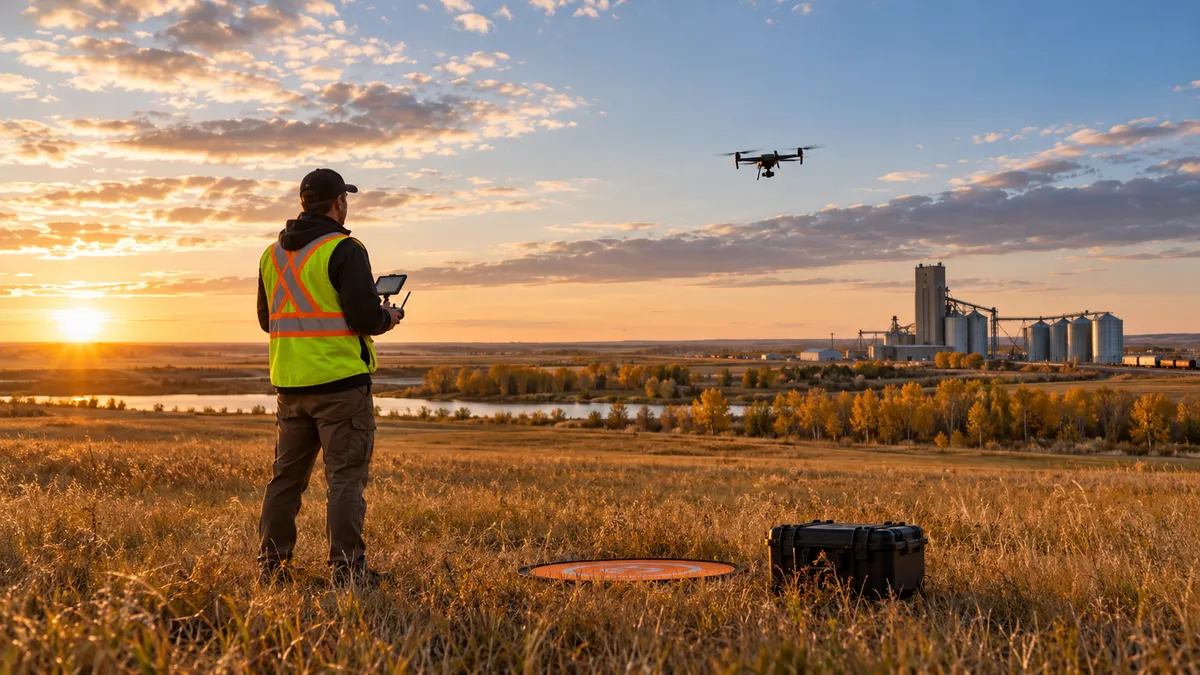
Who needs a drone pilot certificate
In Canada, anyone flying a drone (a remotely piloted aircraft) with an operating weight of 250 g up to and including 150 kg must hold a drone pilot certificate issued by Transport Canada and must register the drone. Operating weight includes anything attached, such as a camera or propeller guards, but not the remote control. Drones under 250 g (microdrones) need no certificate or registration, but the general safety rules still apply.
Which certificate you need depends on what, how and where you fly. Basic operations mean a small drone (250 g to 25 kg), in sight, in uncontrolled airspace, at least 30 m (100 ft) from bystanders, and more than 3 nautical miles from the centre of an airport and 1 nautical mile from a heliport. Anything closer to people, in controlled airspace, closer to an airport, with a medium drone (over 25 kg), or using extended visual line-of-sight (EVLOS) or sheltered operations is an Advanced operation, and most of these also need a drone with the right safety assurance declaration.
The two online exams
| Small Basic Exam | Advanced Exam | |
|---|---|---|
| Questions | 35 multiple-choice | 50 multiple-choice |
| Time limit | 90 minutes | 60 minutes |
| Pass mark | 65% | 80% |
| Minimum age | 14 | 16 |
| After you pass | Pilot Certificate, Basic Operations, issued right away | A flight review with a flight reviewer, then you apply for the Pilot Certificate, Advanced Operations |
Both exams are taken online through Transport Canada's Drone Management Portal, in English or French, and you get your result as soon as you finish. If time runs out, your exam is marked on the answers you gave. If you fail, you must wait 24 hours before trying again, and each new attempt costs the exam fee again. The Advanced flight review must be completed within the 12 months before you apply. Drone pilot certificates do not expire, but before every flight you must have done a recency activity within the last 24 months, such as passing an exam or flight review or completing approved recurrent training.
What the questions cover
Transport Canada says the exam questions are based on TP 15263, Knowledge Requirements for Pilots of Remotely Piloted Aircraft Systems, 250 g up to and including 150 kg, Basic and Advanced Operations. It lists eight knowledge areas, and marks which topics apply to Basic and which to Advanced:
- Air law, air traffic rules and procedures: CARs Part IX (registration, pilot certificates, recency, distances, altitude limits, right of way, alcohol and fitness, records, incidents), airspace classes, forest fire restrictions and aerodrome procedures.
- Airframes, power plants, propulsion and systems: motors and speed controllers, batteries, data links, autopilots and firmware, compass, altimeter and IMU.
- Human factors: vision and scanning, fatigue, medication, alcohol, cold and heat, decision-making, checklists and crew communication.
- Meteorology: pressure, density altitude, cloud, fog, wind, turbulence, fronts, icing, thunderstorms, and reading METARs and TAFs.
- Navigation: VNC and VTA charts, the Canada Flight Supplement, NOTAMs, UTC and local time, variation, and GNSS.
- Flight operations: site surveys, emergency procedures, performance, weight and balance, and for Advanced, EVLOS and sheltered operations.
- Theory of flight: the four forces, stalls, stability, control surfaces, helicopter and multirotor controls, and load factor.
- Radiotelephony: radio terms, emergency calls and the difference between height and altitude.
How this practice test is organized
The question bank is split into seven sections. Six cover the shared Basic knowledge areas, and a separate Advanced Operations section covers the Advanced-only rules: controlled airspace authorizations, flying near and over people, safety assurance declarations, medium drones, EVLOS, sheltered operations and the flight review. The timed mock exam matches the Small Basic Exam: 35 questions in 90 minutes, drawn from the six Basic sections. If you are going for the Advanced certificate, also work through the Advanced Operations section, and remember the real Advanced Exam is tighter: 50 questions in 60 minutes with 80% to pass, so aim to answer in about 70 seconds each.
How to prepare
Read CARs Part IX and TP 15263 with the RPA section of the Transport Canada Aeronautical Information Manual, and use the free RPAS 101 guide that Transport Canada links to. Learn the numbers that come up again and again: 250 g, 25 kg and 150 kg; 30 m and 5 m; 400 ft; 3 NM and 1 NM; 12 hours for alcohol; 24 hours for a retake; 24 months for recency. Practise decoding a METAR, converting UTC to local time and reading a VNC chart with an instructor. Transport Canada strongly recommends a course at a drone flight school before the exam, and it does not publish an official practice exam.
Our questions are original practice questions written from the official sources listed below. They are not real exam questions. This is an independent practice platform and is not affiliated with or endorsed by Transport Canada or NAV CANADA.
Practice questions with answers
Tap a question to see the correct answer and explanation.
What is the maximum altitude for a drone in Basic operations in open country with no buildings nearby?
- 400 ft (122 m) ASL
- 500 ft (152 m) AGL
- 400 ft (122 m) AGL
- 300 ft (91 m) AGL
Answer: C, 400 ft (122 m) AGL. CARs 901.25(1)(a): no pilot shall operate an RPA higher than 400 feet (122 m) above ground level, unless an SFOC or an ATC authorization in controlled airspace allows it.
Which classes of airspace are controlled airspace in Canada?
- Classes A, B and C only
- Classes B, C, D and G
- Classes A, B, C, D and E
- Classes A, B, C, D, E and G
Answer: C, Classes A, B, C, D and E. CARs 601.02(1): controlled airspace is Class A, B, C, D or E (or Class F special use). Class G is uncontrolled.
A METAR contains the group 27015G25KT. What does it mean?
- Wind from 270 degrees magnetic at 25 knots, gusts 15
- Wind from 270 degrees true at 15 knots, gusting to 25 knots
- Wind toward 270 true at 15 knots, gusting to 25
- Wind from 270 degrees true at 15 km/h, gusting to 25 km/h
Answer: B, Wind from 270 degrees true at 15 knots, gusting to 25 knots. In a METAR, the wind group gives the direction the wind is blowing from in degrees true, the speed in knots, and G for the peak gust.