
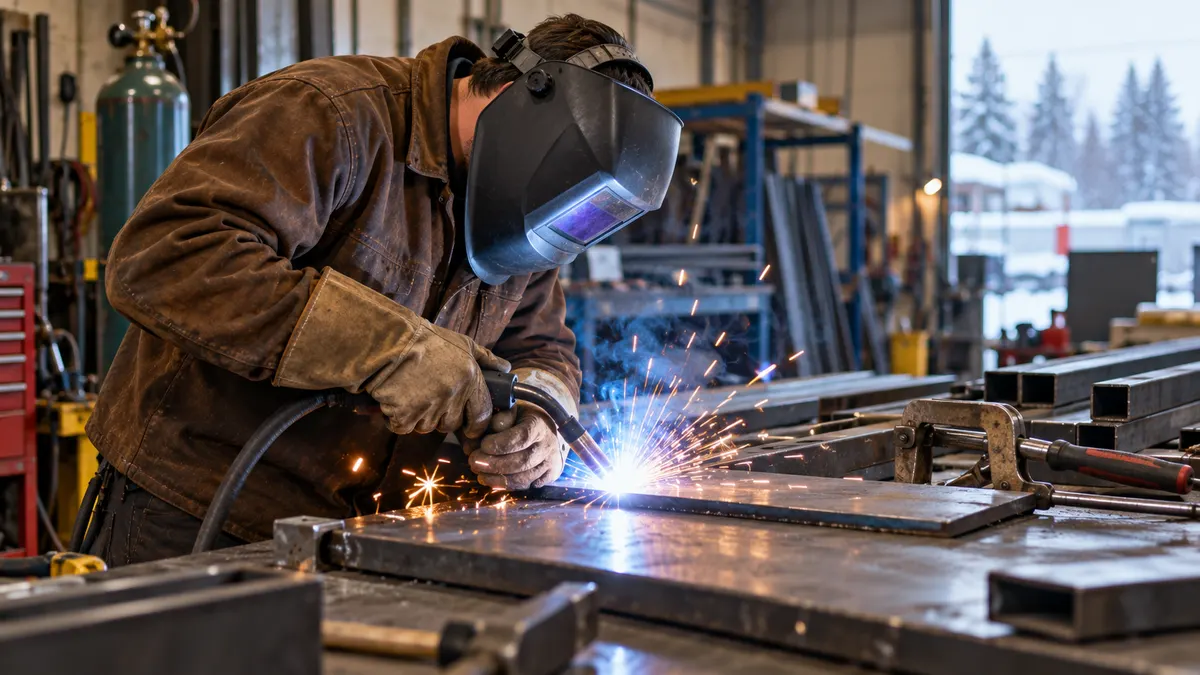
What the Red Seal Welder exam is
The Red Seal Welder exam is the national certification exam for welders in Canada. It has 125 multiple-choice questions based on the Red Seal Occupational Standard for the trade. In Ontario, passing it leads to the Welder (456A) Certificate of Qualification from Skilled Trades Ontario, with the Red Seal endorsement.
Welder is a non-compulsory (voluntary) trade in Ontario under the Building Opportunities in the Skilled Trades Act, 2021. The apprenticeship is about 6,000 hours: 5,280 hours on the job and 720 hours of in-school training over three levels. When you finish your apprenticeship, or are approved through a Trade Equivalency Assessment, you can book the certifying exam. The Ontario welder Certificate of Qualification does not need to be renewed. Some welding work, such as on pressure equipment, also needs a separate welder qualification from the Technical Standards and Safety Authority (TSSA).
| Part of the exam | What to expect |
|---|---|
| Questions | 125 multiple-choice questions |
| Options | Four choices (A to D), exactly one correct |
| Writing time | Four hours |
| Pass mark | 70% |
| Supplied at the exam | A formula sheet, an acronym list and a calculator if needed |
| Exam fee in Ontario | $150 plus HST, paid on the Skilled Trades Ontario Portal |
| Language | English or French in Ontario |
| If you do not pass | A 30-day wait before you can rewrite, and the fee is paid again |
The Red Seal program says that for this trade about 40 to 50% of questions test knowledge and recall, 35 to 45% test procedures and application, and 10 to 20% test critical thinking. Four hours for 125 questions gives you just under two minutes a question.
How the exam is weighted
The official exam breakdown splits the 125 questions across four major work activities. Our four sections follow the same activities, and our 125-question mock exams use the same weighting.
| Major work activity | Red Seal questions | What it covers |
|---|---|---|
| A. Common occupational skills | 20 | Tools and equipment, access and rigging, safety, organizing work, routine trade activities such as inspection and preheat |
| B. Layout and fabrication | 28 | Drawings and welding symbols, layout, calculations, fit-up, distortion control |
| C. Cutting and gouging | 23 | Saws, shears and grinders, oxy-fuel cutting, plasma arc cutting, air carbon arc cutting |
| D. Welding processes | 54 | SMAW (18), FCAW, MCAW and GMAW (18), GTAW (13) and SAW (5) |
The welding processes carry the most weight, so know your electrode classifications, polarity, transfer modes, shielding gases and the causes of common defects.
Calculations on the formula sheet
The Red Seal formula sheet for welders gives pi as 3.1416 and the formulas for the area of a circle and a triangle, the circumference of a circle, the length of an arc and the volume of a cylinder. Practise these with real layout numbers until they are quick, and convert units before you multiply. You should also be comfortable with fractions of an inch and millimetres, drawing scales and the 3-4-5 method for squaring.
How to prepare
Start with the Red Seal exam breakdown and self-assessment to find your weaker areas. Study from the occupational standard as well as your in-school notes, because the exam covers the full scope of the trade across Canada. Drill one section at a time here, read every explanation, and finish with full timed mocks of 125 questions in four hours. Aim well above 70% in practice.
Checked against Red Seal Program and Skilled Trades Ontario information on October 12, 2026. Last reviewed: October 2026.
Aptitude Tests Canada is an independent practice platform. We are not affiliated with or endorsed by Skilled Trades Ontario, the Red Seal Program, the TSSA or the Government of Ontario. Our questions are original practice questions, not real exam questions, and they do not reproduce CSA or CWB standards.
Practice questions with answers
Tap a question to see the correct answer and explanation.
When choosing a filter lens for arc welding, how should the shade number change as welding current goes up?
- Use a lower (lighter) shade number
- Use a higher (darker) shade number
- Switch to a clear lens and tinted goggles
- Keep the same shade for every current
Answer: B, Use a higher (darker) shade number. The higher the current, the brighter the arc and the more ultraviolet and infrared it gives off. Shade guides call for a darker filter, with a higher number, as amperage rises.
On a welding symbol, what does a small circle at the junction of the arrow and the reference line mean?
- Field weld
- Flush contour
- Melt-through
- Weld all around
Answer: D, Weld all around. A circle where the arrow meets the reference line is the weld-all-around symbol. It means the weld continues completely around the joint.
In oxy-fuel cutting, to what condition must the steel be heated before the cutting oxygen is turned on?
- A dull grey colour, just above room temperature
- Its melting point, so it starts to drip
- Its boiling point, so it starts to give off fume
- Its kindling temperature, a bright red colour
Answer: D, Its kindling temperature, a bright red colour. Steel must be preheated to its kindling (ignition) temperature, a bright cherry red. At that point the jet of pure oxygen makes the iron burn rapidly, and the oxide is blown out of the kerf.