
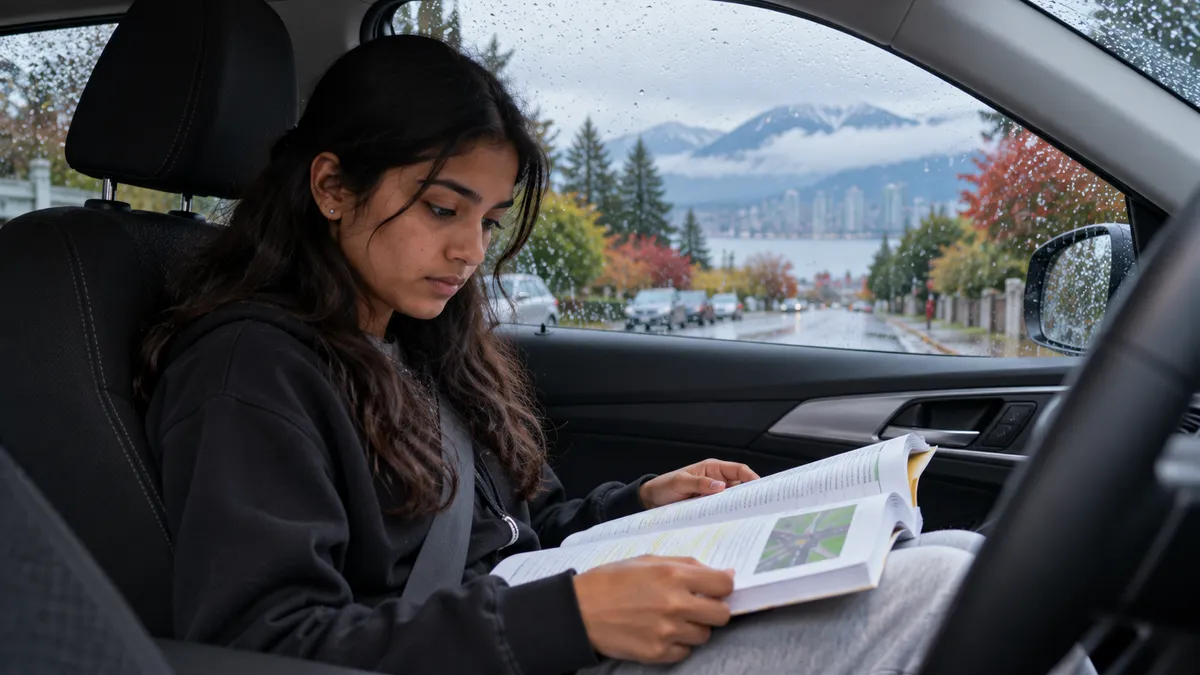
What the ICBC knowledge test is
To get a Class 7 learner's licence (Class 7L) in British Columbia, you pass the passenger vehicle knowledge test run by the Insurance Corporation of British Columbia (ICBC). It checks that you know the road signs, signals and markings, the rules of the road and safe driving practices in ICBC's driving guide, Learn to Drive Smart. A vision and medical screening is a separate step before your learner's licence is issued, and it is not part of the scored test.
Test format at a glance
| Part of the test | What to expect |
|---|---|
| Questions | 50 multiple-choice questions on a computer |
| Time | 45 minutes |
| Pass mark | 40 correct out of 50 (80%) |
| How it ends | The test can end early once you reach the number of correct answers needed, or go over the number of wrong answers allowed. You can skip each question once. |
| Cost | $15 per knowledge test attempt. The learner's licence fee is separate. |
| Where | In person at a driver licensing office, or online at home for eligible B.C. residents since June 9, 2026. After an online pass you still visit a licensing office for identity, vision and licensing steps. |
| Languages | In person, the test is offered in 12 languages with audio: English, Arabic, Cantonese, Croatian, Farsi, French, Mandarin, Punjabi, Russian, Spanish, Vietnamese and Ukrainian. |
ICBC warns that some answer choices are partly correct but incomplete, so read every option before you choose. ICBC does not publish a table of topic weightings, so our sections follow the Learn to Drive Smart chapters the test is drawn from (chapters 2 to 9).
The new graduated licensing rules (October 19, 2026)
B.C. changed its Graduated Licensing Program on October 19, 2026, and our questions use the current rules. The supervisor's minimum age dropped from 25 to 22, and an immediate-family exemption was added to the Class 7L passenger limit. The learner stage is 12 months if you are under 25 and 9 months if you are 25 or older. The novice stage is 24 months if you are under 25 (18 with an approved course) and 12 months if you are 25 or older. The second road test was replaced by a Driving Record Assessment, and there is a new 12-month Class 5 restriction 55 (zero alcohol and drugs). The printed chapter 9 of Learn to Drive Smart still shows the older rules, so check ICBC's Class 7L page and its graduated licensing changes page as well.
How our sign questions work
The real test shows road signs as pictures. Our site does not use images, so every sign question describes the sign in words: its shape, colour and symbol. That builds the habit the test rewards, which is recognizing a sign by its shape and colour first. Fine amounts and penalty points are left out on purpose, because the printed guide's figures are dated.
What our practice test covers
| Section | What it covers |
|---|---|
| Traffic signs | Regulatory, warning, construction and guide signs by shape, colour and symbol |
| Traffic signals and road markings | Lights, arrows, flashing signals, pedestrian signals, lane lines and crosswalks |
| Intersections and right-of-way | Four-way stops, uncontrolled intersections, roundabouts, left turns and yielding |
| Lanes, turns, passing and parking | Lane choice, turning, passing safely and parking rules |
| Speed, space and See-Think-Do | Speed limits, following distance, scanning and the See-Think-Do strategy |
| Sharing the road | Pedestrians, cyclists, motorcycles, large vehicles, school buses and emergency vehicles |
| Hazards, emergencies, impairment and distraction | Weather, winter driving, skids, emergencies, alcohol, drugs, fatigue and phones |
| Licensing, GLP and vehicle safety | Class 7L conditions, the new graduated licensing rules, seatbelts and vehicle checks |
How to prepare
Read Learn to Drive Smart chapters 2 to 9, then check the current Class 7L page because the learner rules changed in October 2026. Practise one section at a time, starting with signs and right-of-way, and read every explanation, including for the questions you got right. Then take the 50-question timed mock and aim for well above 40 correct, so a few tricky questions on the day will not stop you.
Checked against ICBC and Government of British Columbia information on October 30, 2026. Last reviewed: October 2026.
Aptitude Tests Canada is an independent practice platform. We are not affiliated with or endorsed by ICBC, RoadSafetyBC or the Government of British Columbia. Our questions are original practice questions, not real test questions.
Practice questions with answers
Tap a question to see the correct answer and explanation.
A downward-pointing triangular sign with a red border and white centre means:
- Give the right-of-way to other vehicles and crossing pedestrians
- Stop completely at the line, then proceed when it is clear
- Merging traffic will join from the right ahead
- Do not enter this road from this direction
Answer: A, Give the right-of-way to other vehicles and crossing pedestrians. The triangular yield sign tells you to let traffic and pedestrians on the through road go first, stopping if necessary (Learn to Drive Smart, ch. 3).
A steady yellow light appears as you approach an intersection. What should you do?
- Stop before the intersection unless you cannot safely stop in time
- Speed up so that you clear it before the light turns red
- Continue at the same speed because yellow means caution
- Stop in the middle of the intersection and wait
Answer: A, Stop before the intersection unless you cannot safely stop in time. A steady yellow means the light is about to turn red; you must stop before entering unless you cannot safely stop in time (Learn to Drive Smart, ch. 4).
You approach an uncontrolled intersection and another vehicle has already arrived from a side street. What should you do?
- Speed up so that you clear the intersection first
- Slow down and yield to the vehicle that arrived first
- Sound your horn and proceed
- Continue, because you are on the wider road
Answer: B, Slow down and yield to the vehicle that arrived first. At an uncontrolled intersection, if another vehicle has arrived before you, slow down and yield (Learn to Drive Smart, ch. 4).