
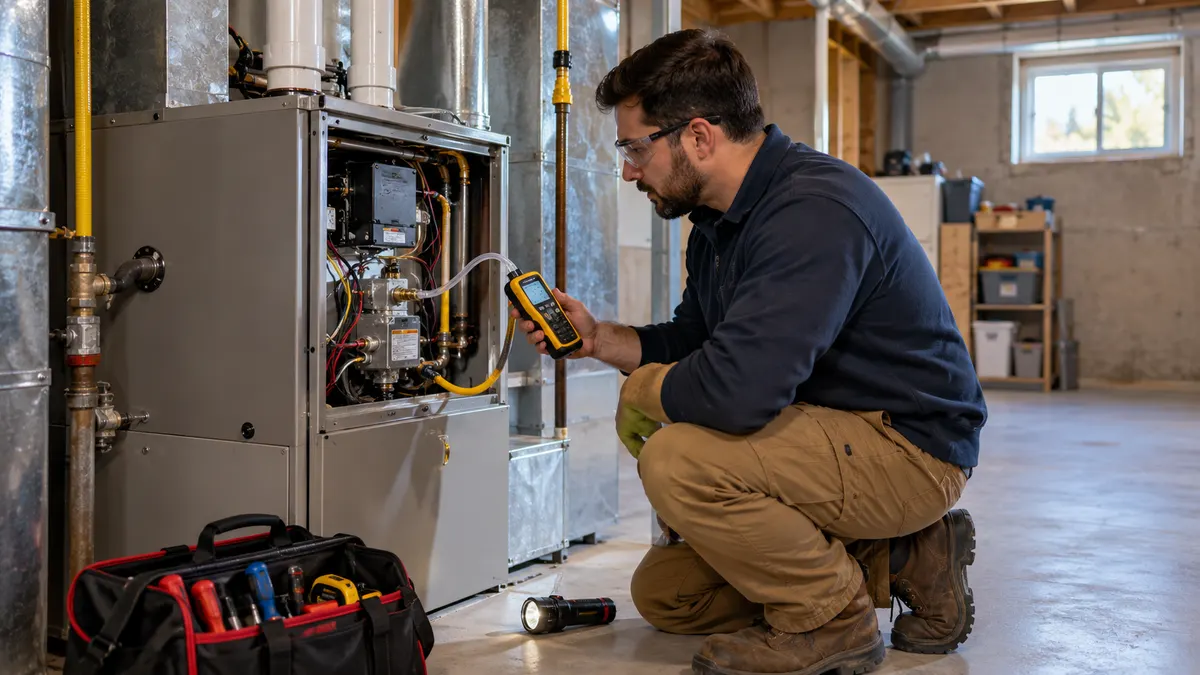
What the TSSA G3 exam is
The TSSA G3 exam is the written certification exam for the Gas Technician 3 certificate in Ontario, the entry level of the gas technician certificates (G3, G2 and G1). It is run by the Technical Standards and Safety Authority (TSSA). You need at least 75% on the exam and 75% on a practical evaluation to be certified.
Gas technician certificates are issued under the Fuel Industry Certificates regulation (O. Reg. 215/01) made under the Technical Standards and Safety Act, 2000. Gas work in Ontario follows the Gaseous Fuels regulation (O. Reg. 212/01) and the CSA B149.1 Natural Gas and Propane Installation Code, with CSA B149.2 for propane storage and handling.
Two ways to get your G3
- Training program. Complete a program with an accredited training provider that uses a TSSA-approved curriculum. Your provider sends proof of training to TSSA, then you apply for the exam through the TSSA Client Portal.
- Challenge. Without formal training, you can apply to challenge the exam through the TSSA Client Portal. If you pass the written exam, you also complete a practical skills assessment arranged with TSSA. A challenge approval lasts 12 months, and you can ask TSSA for an extension before it expires.
Key facts
| Item | What TSSA says |
|---|---|
| Exam pass mark | 75% or higher on the TSSA certification exam |
| Practical | 75% or higher on the practical evaluation for the applicable modules |
| Exam length | Up to 3.5 hours. TSSA says its multiple-choice exams typically have 50 to 165 questions, depending on the certificate |
| Booking | You schedule the exam on Prometric's website |
| Allowed references | The Technical Standards and Safety Act, 2000, the fuels regulations and code adoption documents, CSA B149.1 and CSA B149.2 |
| Retake | A 30-day wait after a failed fuels exam |
| Failed attempts | After three failed exam attempts, you must complete an accredited training program before you can rewrite |
| Practical records | G3 holders must complete and keep the Gas Technician 3 Sign-Off Document |
| Renewal | TSSA sends a renewal invoice before expiry; a certificate expired for more than 12 months needs recertification |
| Next level | From January 1, 2026, challenge-route G3 holders need proof of 450 hours of G3 work experience to enrol in a G2 program |
TSSA does not publish an exact question count for the G3 exam, so check your exam booking details. Fees are listed in TSSA's fuels fee schedules.
What our practice test covers
Our questions are grouped into seven sections that cover the knowledge a G3 technician needs: safety and the properties of natural gas and propane; codes, acts and regulations; tools, fasteners and test instruments; basic electricity; piping and tubing systems; gas appliances and venting; and customer relations. Calculations include clocking a gas meter, reading a manometer, converting pressure units and Ohm's law. Our timed mock is 100 questions in three hours, scored against the 75% pass mark. That is our own practice format, not TSSA's.
How to prepare
Learn the properties of each fuel gas well, because many questions turn on them: which gas rises and which sinks, how much air each needs, and their typical supply pressures. Know the purpose of every safety device on an appliance. Practise the calculations until they are quick, read every explanation, and aim well above 75% before you book.
Checked against TSSA and Government of Ontario information on October 14, 2026. Last reviewed: October 2026.
Aptitude Tests Canada is an independent practice platform. We are not affiliated with or endorsed by the TSSA, CSA Group or the Government of Ontario. Our questions are original practice questions, not real exam questions, and they do not reproduce the CSA B149 codes.
Practice questions with answers
Tap a question to see the correct answer and explanation.
Why is an odorant such as mercaptan added to natural gas?
- To raise its heating value
- So leaks can be smelled
- To make the flame blue
- To stop the gas from freezing
Answer: B, So leaks can be smelled. Natural gas has almost no smell of its own. A sulphur-based odorant gives it the familiar rotten-egg smell so people can detect leaks.
Which CSA code is the main installation code for natural gas and propane appliances and piping?
- CSA B149.2
- CSA B149.1
- CSA B52
- CSA C22.1
Answer: B, CSA B149.1. CSA B149.1 is the Natural Gas and Propane Installation Code. B149.2 covers propane storage and handling, B52 is refrigeration and C22.1 is the Canadian Electrical Code.
Where is thread sealant applied on a threaded gas pipe joint?
- On the female threads only
- Inside the pipe bore
- On both threads heavily
- On the male threads only
Answer: D, On the male threads only. Apply an approved gas thread sealant to the male threads only, keeping it off the first thread, so sealant does not get pushed into the pipe.