
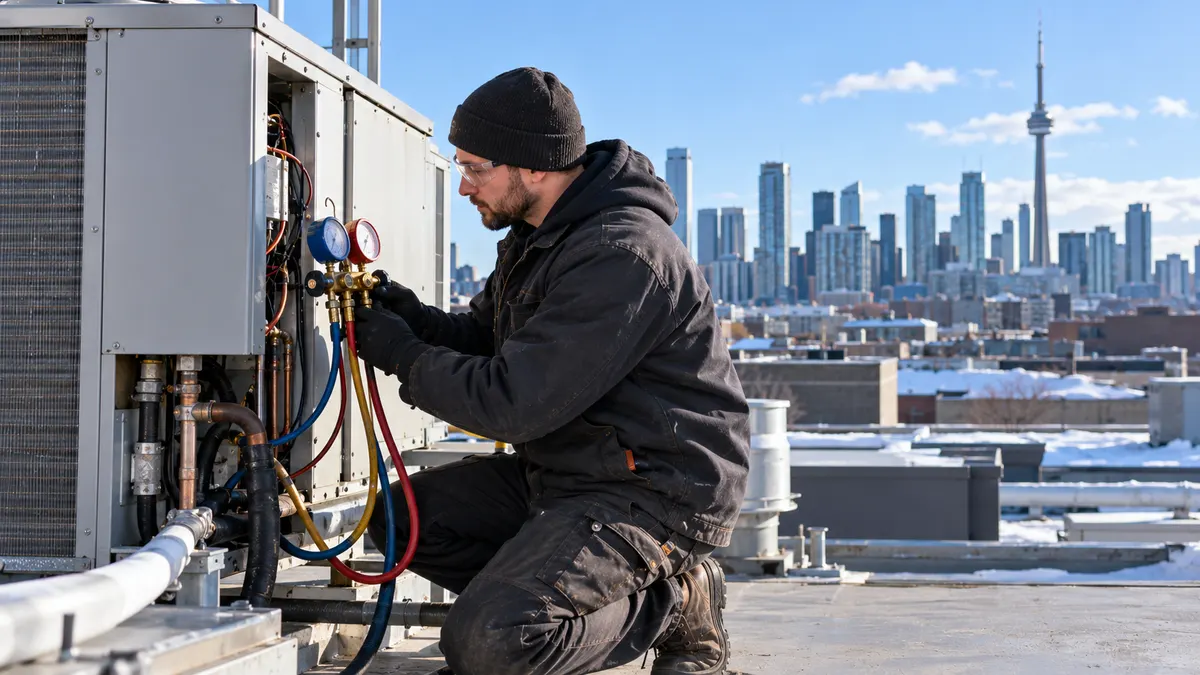
What the 313A exam is
The 313A exam is the certifying exam for Refrigeration and Air Conditioning Systems Mechanic in Ontario. It is the Red Seal Refrigeration and Air Conditioning Mechanic exam: 125 multiple-choice questions based on the Red Seal Occupational Standard. Passing it leads to your Certificate of Qualification from Skilled Trades Ontario, with the Red Seal endorsement.
This is a compulsory trade in Ontario under the Building Opportunities in the Skilled Trades Act, 2021. To work in it legally you must hold a Registered Training Agreement, a Provisional Certificate of Qualification or a Certificate of Qualification, and appear on the Skilled Trades Ontario Public Register. The apprenticeship is 9,000 hours: 8,280 hours on the job and 720 hours of in-school training over three levels. The Certificate of Qualification must be renewed to stay valid.
| Part of the exam | What to expect |
|---|---|
| Questions | 125 multiple-choice questions |
| Options | Four choices (A to D), exactly one correct |
| Writing time | Four hours |
| Pass mark | 70% |
| Supplied at the exam | A formula sheet, an acronym list and a calculator if needed |
| Exam fee in Ontario | $150 plus HST, paid on the Skilled Trades Ontario Portal |
| If you do not pass | A 30-day wait before you can rewrite, and the fee is paid again |
The Red Seal program says that for this trade about 20 to 30% of questions test knowledge and recall, 50 to 60% test procedures and application, and 10 to 20% test critical thinking. Most questions ask you to apply what you know to a real job situation.
How the exam is weighted
The official exam breakdown splits the 125 questions across six major work activities. Our six sections follow the same activities, and our 125-question mock exams use the same weighting.
| Major work activity | Red Seal questions | What it covers |
|---|---|---|
| A. Common occupational skills | 13 | Safety, tools and instruments, organizing work, communication and mentoring |
| B. Routine trade activities | 19 | Site preparation, refrigeration theory, pressure and temperature, refrigerants and oils, basic electricity |
| C. Planning installation | 18 | Planning HVAC/R systems and control systems, load and airflow calculations, codes |
| D. Installation | 26 | Piping, brazing, pressure testing, evacuation, electrical and control wiring |
| E. Commissioning | 21 | Start-up, charging, airflow and water flow, control checks and records |
| F. Maintenance and service | 28 | Diagnosis, repairs, refrigerant recovery, electrical faults, control service |
Calculations you should be fast at
The formula sheet gives the constants and formulas, but not which one to use. Practise these until they are automatic:
- Tons and Btuh. 12,000 Btuh is one ton.
- Air. Sensible heat = CFM x 1.08 x temperature difference, and CFM = fpm x area.
- Water. Btuh = 500 x USGPM x temperature difference.
- Pressure. psia = psig + 14.7, kPa x 0.1450 = psi, and 0.433 psi per foot of water.
- Superheat and subcooling. Read the saturation temperature from a P-T chart, then compare it with the line temperature.
- Pulleys and air mixing. d1 x rpm1 = d2 x rpm2, and outdoor air % = outdoor air CFM / total CFM x 100.
Refrigerant handling in Ontario
Separately from your Certificate of Qualification, Ontario requires anyone who buys or handles ozone-depleting refrigerants and other halocarbons, such as HCFCs and HFCs, to hold an ozone depletion prevention (ODP) certificate card under O. Reg. 463/10. The Ontario government says the card comes from a one-day course with a pass mark of 75% and is valid for five years.
How to prepare
Start with the Red Seal exam breakdown and self-assessment to find your weaker areas. Study from the occupational standard as well as your college notes. Drill one section at a time here, read every explanation, and finish with full timed mocks of 125 questions in four hours. Aim well above 70% in practice.
Checked against Red Seal Program, Skilled Trades Ontario and Government of Ontario information on October 12, 2026. Last reviewed: October 2026.
Aptitude Tests Canada is an independent practice platform. We are not affiliated with or endorsed by Skilled Trades Ontario, the Red Seal Program or the Government of Ontario. Our questions are original practice questions, not real exam questions, and they do not reproduce CSA B52 or any other code.
Practice questions with answers
Tap a question to see the correct answer and explanation.
What is the main risk to your skin and eyes if liquid refrigerant escapes from a hose?
- Chemical burns from acid in the oil
- Frostbite from rapid evaporation
- Sunburn from ultraviolet light
- Electric shock from static build-up
Answer: B, Frostbite from rapid evaporation. Liquid refrigerant boils off very quickly at atmospheric pressure and can freeze skin and eye tissue in seconds. Wear safety glasses or goggles and gloves when connecting and disconnecting hoses.
How many Btuh are in one ton of refrigeration?
- 3 412 Btuh
- 12 000 Btuh
- 288 000 Btuh
- 1 000 Btuh
Answer: B, 12 000 Btuh. One ton of refrigeration is 12 000 Btuh. It comes from the heat needed to melt one ton of ice in 24 hours (288 000 Btu over 24 hours).
A building cooling load is 54 000 Btuh. What is this load in tons of refrigeration?
- 6.0 tons
- 5.4 tons
- 4.5 tons
- 4.0 tons
Answer: C, 4.5 tons. 54 000 / 12 000 = 4.5 tons. Equipment is then selected from manufacturer data to match the calculated load as closely as possible; avoid greatly oversizing, and do not round down to a size that cannot meet the load.